
'Vajpayee used to consult the Opposition; Indira Gandhi used to consult the Opposition. Which khet ki mooli is Modi?'

There is nothing to be worried about as bilateral ties are robust with solid foundations. Both are on the same page on the economic and defence/security ties bilaterally and globally and that shall continue irrespective of change in political dispensation in either country, points out Dr Rajaram Panda.
This columnist cannot pretend to be an economic expert but can certainly point out that the statistics being reeled out on a daily basis now, have added to the economic burden of the people, says Seema Mustafa.
The eighth Budget of Finance Minister Nirmala Sitharaman continued to focus on 'GYAN' (Garib, Youth, Annadata, Nari) to maintain a consistent and coherent strategy initiated over the years in pursuing the government's vision for Viksit Bharat. The approach, characterised by incremental yet impactful steps, aims to create a compounding effect over time.

Global rating agency Fitch on Thursday affirmed India's 'BBB-' rating with a stable outlook on strong growth outlook and fiscal credibility. Fitch said India is set to remain among the fastest-growing sovereigns globally with GDP growth of 7.2 per cent in the current fiscal year and 6.5 per cent in FY26, down from 8.2 per cent in FY24. "Fitch Ratings has affirmed India's Long-Term Foreign-Currency Issuer Default Rating (IDR) at 'BBB-' with a Stable Outlook," the global rating agency said in a statement.

Nirmala Sitharaman on Wednesday assumed charge as the Finance and Corporate Affairs Minister for the second consecutive term and is slated to soon present the final Budget for FY '25 that is going to set the tone for the Modi 3.0 government's priorities and direction for Viksit Bharat. Upon her reaching the North Block office, Sitharaman was greeted by Finance Secretary T V Somanathan and other top officials. Minister of State for Finance Pankaj Chaudhary was also present. Chaudhary assumed charge on Tuesday evening.

This Women's Day Week, we pay tribute to the extraordinary courage, resilience, and leadership of three iconic Indian queens -- Rani Lakshmibai of Jhansi, Rani Chennamma of Kittur, and Maharani Ahilyabai Holkar of Malwa.

'Consider 40% to 50% in equities, 10% in gold as a hedge, and the remaining 30% to 40% split between multi-asset funds and hybrid funds.'

IMF believes it is mostly cyclical, not structural, but because of the financial sector issues, recovery will be not be quick. IMF said, it saw an opportunity with the strong mandate of the new government to reinvigorate the reform agenda to boost inclusive and sustainable growth.

"The theme of tomorrow's meeting is 'Economic Policy Reform, Road Ahead'. The prime minister will make opening remarks. There are 15 invitees who will make their presentations before the prime minister," a senior government official said.

Economic reforms seem to be on a slow train, while good old fiscal populism is alive and flourishing.
From the Sensex pack, Adani Ports & Special Economic Zones, Mahindra & Mahindra, Reliance Industries, HDFC Bank, Larsen & Toubro, NTPC, State Bank of India, UltraTech Cement and Kotak Mahindra Bank were the major gainers. In contrast, Tata Steel, Titan, Bajaj Finserv, JSW Steel, Bajaj Finance, Hindustan Unilever, ITC, Tata Motors and Tata Consultancy Services were among the laggards.
'... the government provides adequate cash and kind support for the poorest of the poor for survival... ...conditional cash and skilling support for the economically poor to raise their incomes to adequate levels... ...and make functional arrangements for providing unemployment allowance to the vulnerable poor during disasters like the present one.'

IMF, which has also lowered its global economic growth forecast for 2016 and 2017 by a marginal 0.1 per cent to 3.1 and 3.4 per cent respectively, recommended six 'reform priorities' for India

Chaudhary Charan Singh, who on Friday was conferred with India's highest civilian award Bharat Ratna, is popularly known as a champion of farmers.

Finance Minister Nirmala Sitharaman on Thursday announced a Rs 11.11 lakh crore spending on infrastructure and vowed to continue reforms as she resisted resorting to populist measures in Modi government's last Budget before general elections, instead choosing to stay on the path of cutting deficit while bolstering measures for focus groups.

Pragmatism and flexibility is a virtue. An untethered and short-term approach to policymaking is a flaw, argues Mihir S Sharma.

A way out of the economic slump is to revisit the template of 15 years ago and follow its constituents, recommends Ajay Shah.
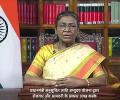
'Today, let us reaffirm our commitment to strive to realise Gandhiji's dreams. His watchwords, truth and nonviolence, will continue to remain relevant for the whole world. He also taught us that rights and duties are but the two sides of the coin - indeed, the true source of rights is duty. Today we recall his lessons in compassion too - compassion not only for our human neighbours but also for our other neighbours, namely, flora and fauna, rivers and mountains.'
It is increasingly clear that Rajasthan, under the leadership of Chief Minister Vasundhara Raje, will lead the country in terms of policy reform.

FDI is a major driver of economic growth and a source of non-debt finance for the economic development of the country. The government has put in place an investor-friendly policy on FDI, under which investment up to 100 per cent is permitted on the automatic route in most sectors/ activities. At $ 64.37 billion, FDI in 2018-19 is the highest ever investment received for any financial year.

Reddy has worked to reform the economy.
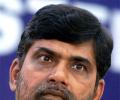
The truth is not that Chandrababu Naidu's centre-right policies led to his defeat but rather almost the reverse: his defeat, and for that matter that of the NDA at the Centre, was widely -- but falsely -- interpreted as a rejection of their economic policies, rather than put down to bad luck and conventional anti-incumbency., say Vivek Dehejia and Rupa Subramanya.
Prime Minister Narendra Modi said the liberalisation of policies governing the acquisition and production of geospatial data is a "massive step in government's vision for an Aatmanirbhar Bharat". The reform will benefit country's farmers, start-ups, private sector, public sector and research institutions to drive innovations and build scalable solutions, he said.

It's time India re-visited its Western alliances for the attitude and approach that the West reserves for the nation when it comes to security cooperation of the kind that they might not have visualised outside of China, India's bug-bear, asserts N Sathiya Moorthy.
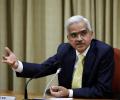
Reserve Bank Governor Shaktikanta Das on Wednesday said the country is at the doorstep of economic revival on the back of accommodative monetary and fiscal policies being pursued by the central bank and the government.

The Economic Survey released before next year's Budget could become a single volume, reverting to the practice followed till FY14. "There is so much to write about the Indian economy's performance in the past year. "Most of the exciting themes will be covered in what used to be considered Part II," said a senior government official who is part of the preparations for the Survey.

IMF has praised India's economic performance and has negated the concept of decoupling as economies today are much closely related to each other.

Throughout 2022, China turned to the PLA as an increasingly capable instrument of Statecraft, strengthening its ability to 'fight and win wars' against a 'strong enemy', points out Ajai Shukla.
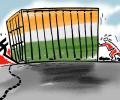
India needs a National Trade Policy Council, chaired by a minister who reports directly to the PM, says Jayanta Roy, former economic advisor to the Union commerce ministry.

'Some of the astounding proposals, if translated into statutory provisions, would be suicidal.' 'This would not be a wonder cure for increasing insurance penetration and only result in mushrooming growth of players like paan kiosks with deleterious consequences.'

International Monetary Fund Chief Economist Gita Gopinath tells Indivjal Dhasmana high-frequency indicators for the third quarter of 2021 indicate momentum in economic recovery in India.
India's economic growth during 2011-12 slipped to nine-year low of 6.5 per cent and during the first quarter of the current fiscal it was 5.5 per cent.

The external affairs minister also recalled how Pandit Nehru was hesitant in taking assistance from the United States following the 1962 war with China as he was unsure how it would be seen.

Few finance ministers announce any taxation measure that could upset the stock market. Ms Sitharaman decided to take that risk, observes A K Bhattacharya.

'I am optimistic about the Budget because of the fiscal discipline the government has committed to.'

In a post on X, Modi said, "Happy to have welcomed @POTUS @JoeBiden to 7, Lok Kalyan Marg. Our meeting was very productive."
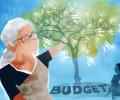
Finance Minister Nirmala Sitharaman will present the Union Budget for 2023-24 in Parliament on February 1. The Budget is a statement of the government's estimated receipts and expenditures for a fiscal year (April 1 to March 31). It's divided into Revenue and Capital Budget. The Revenue Budget includes the government's revenue receipts and expenditures while the Capital Budget includes its capital receipts and payments.

This will, of course, go a long way in meeting the promised fiscal deficit target of 3.6 per cent of GDP in 2015-16.
However, Icra Rating Principal Economist Aditi Nayar feels that the numbers are a bit too optimistic and need real heavy-lifting by the Centre and the states. "The survey forecasts on real and nominal GDP will require a substantial push from Central and state spending as private sector capacity expansion is anticipated to be intermittent, and sector-specific in the next couple of quarters," she said. Nayar added that private consumption is likely to chart a differentiated recovery across income and age groups. Based on the comments made in the Survey, she expects the Union Budget to incorporate a growth in gross tax revenue of 15-16 per cent.
